Meg Giordano
Answers are, I think, way overrated. So are statements. What do they leave you to say? “Okay.” Where else can you go? Statements often mark the end of an interaction, the conclusion of a moment, the final breath of a possibility. Questions, on the other hand, are incredibly flexible, inspiringly fluid, and surprisingly intimate. If the stuff of life occurs in the synapses between we meaning-makers, then questions, not statements, must surely be our tool of trade.
We are, nevertheless, oddly fixated upon answers, and the internet is of course ready and waiting with them. I can unearth the answers of life, if only I will supply the questions. Be wary, however, viewers at home: this is epistemological Hamburger Helper. The stuff in the box is worth all of about twenty-five cents, while YOU supply the meat, the whole point of the meal. A well-worded question is the true artistry of life, the ultimate fruit of loving labor, the most valuable of verbal commodities.
I have an ongoing romance with questions. A good question afloat will distract me as powerfully as the smell of cinnamon rolls they fan into the air at the shops. I will mentally wander away from a perfectly good, utilitarian exchange to examine a wildflower of a question growing by the side of a conversational road.
I began to discover the marvelous nuance of questions when I was about twelve, and had bought a piece of jewelry at a bazaar for maybe seventy-five cents. My friend’s great-grandmother looked at the pin and told me I had made a good purchase – it was a quality piece. I was fascinated, eager to see through her eyes, and asked “How do you know?” She misunderstood my question, thought I was challenging her, and in a very few words put me in my place, snappy old Scottish lady that she was. I regretted that she thought I was sassing her, but I was even more affected by the apparently significant difference between “How do you know?” and “How can you tell?” Clearly, something in the way I spoke had communicated the one and not the other, and that, I saw, had made a tremendous difference. I went on my way that day to other things, but I was hooked. The power of the question had taken hold of me.
Why is this? How do questions fling open wide the doors of our souls in ways that statements never can? Perhaps because good questions typically recognize another person as essential participant in a shared moment. Questions transform a mere ‘audience’ into an intimate, second-person ‘you.’ Good questions call for a response. A response seems to me terrifically, intrinsically different from an ‘answer.’ A response remains open toward the asker, and hopes for the exchange to continue. Responses are the weft to a question’s warp, the two interweaving in a dance that becomes a living tapestry. Questions, and their responses, even somewhat contrary ones, make evident the changes that arise within ourselves from interacting with another person – we cannot engage another soul and leave no fingerprint.
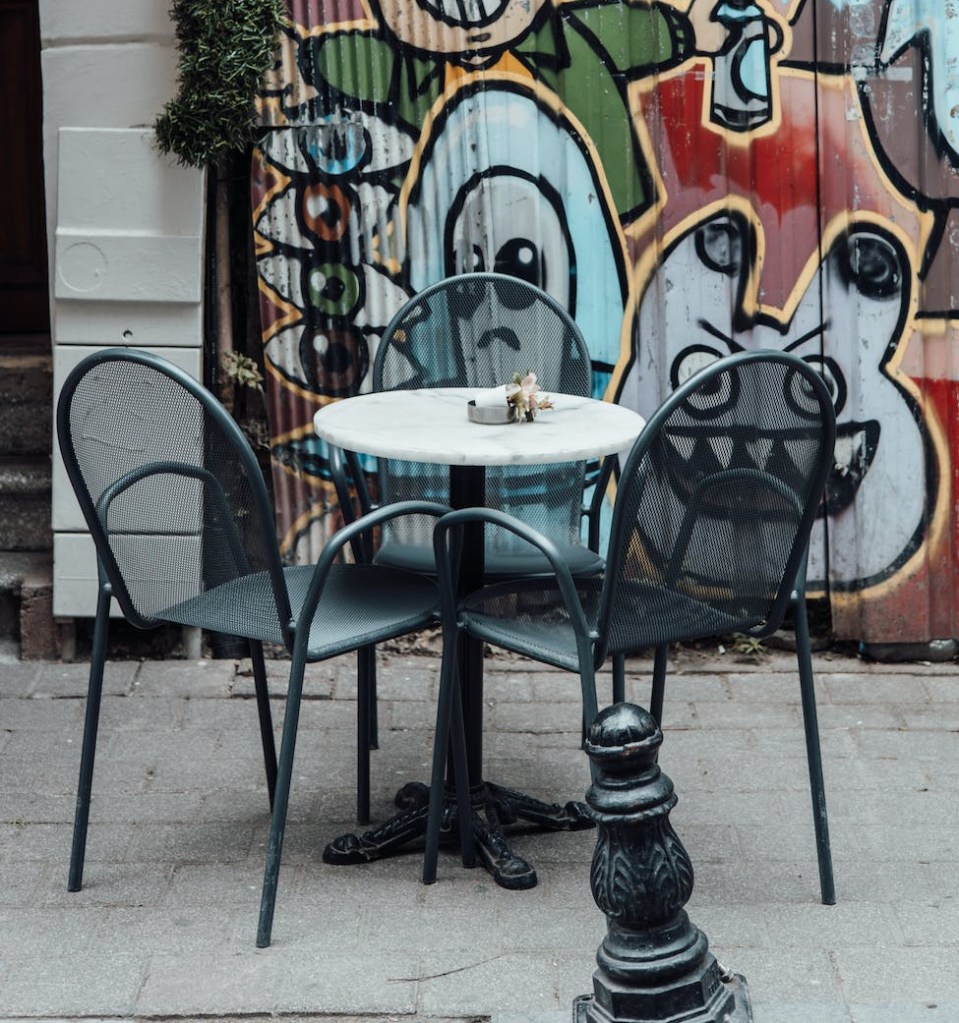
By contrast, a statement gives the sad impression of needing only a sender, not a receiver, in order to exist. A statement can be just shot off into the air, like Longfellow’s arrow, landing unseen and unmarked, not even craving the consolation of reappearing later as that famous and friendly shaft did. It is relatively self-contained, almost smug in its completeness and self-sustaining success. Not so with a question. A question is a living thing, looking for another soul to receive it, entertain it, enlarge it. A question can never be all it is meant to be if it stays in isolation. Its very existence testifies to the value and importance of the other person and what they may offer of themselves in response. By nature it is a joiner, a conjunction, a cafe on a corner with tables for two or three out on the sidewalk. Pull up a chair, have a cup of espresso or chai.
For me, a good question is one of the most intimate, dynamic things that happen in a relationship. It can make you feel seen, known, cared for. Questions don’t just take note of what is – they attend to why what is matters. The facts of our days, years, and lives are transformed into the value-rich good, bad, ugly, and glorious through questions. If a relationship has become stale, the good news is that we are as new as our questions, as fresh as the next unfinished thought I toss to you, or you to me.
What is the source of a question’s power? Wherein lies its magic? Perhaps it is in its ability to resist the human urge to be the hero, the one to fill the space, define the problem, solve the crisis, complete the circle. We love to connect the dots, color in the spaces, make everyone laugh, cause everyone to go “hmmm!” Consider the language we use when we talk about supplying answers, how superior and even dominating the words can be: simplify, solve, correct, evaluate, reduce to simplest terms, label, fix the errors, fill in the blank. (Heaven forbid there should be a parcel of space that we do not rush to fill with something, anything!) That is quite a view of our verbal and mental abilities! We as a race either are tragic overachievers or think way too highly of ourselves. Maybe the magic is found in trying to break free of this gravitational pull of human nature. Maybe that’s what makes a really good question – one that is not easily subdued and corralled by our own cleverness, one that defies our attempts to supply ready answers, pre-packaged and waiting. One that honestly, and humbly, believes that living with uncertainty or even darkness for a bit – ours or someone else’s – is a perfectly reasonable way to think about something important.
A good question. There is nothing, for me, more powerful, more intimate, or more alluring than a good question. I’ve been told by my family that my tombstone should have on it something along the lines of the Latin phrase: Illa est bona quaestio. What does that mean? That is a good question!


 Meg Giordano
Leave a reply to meggior Cancel reply